Family Law Solicitors
When parents separate, it may not always be possible to resolve financial arrangements for a child through the usual channels. In some circumstances, an application under Schedule 1 of the Children Act 1989 can provide an additional route to secure financial provision for a child’s benefit. Depending on the circumstances, the court can make a range of financial orders to help meet a child’s needs following a separation, regardless of whether the parents were never married or in a civil partnership.
Whether you’re considering an application or need advice about your position, our family law solicitors can help you understand the options available and the factors that could affect your case.
If you need financial support for your child following a separation, there are two main options available:
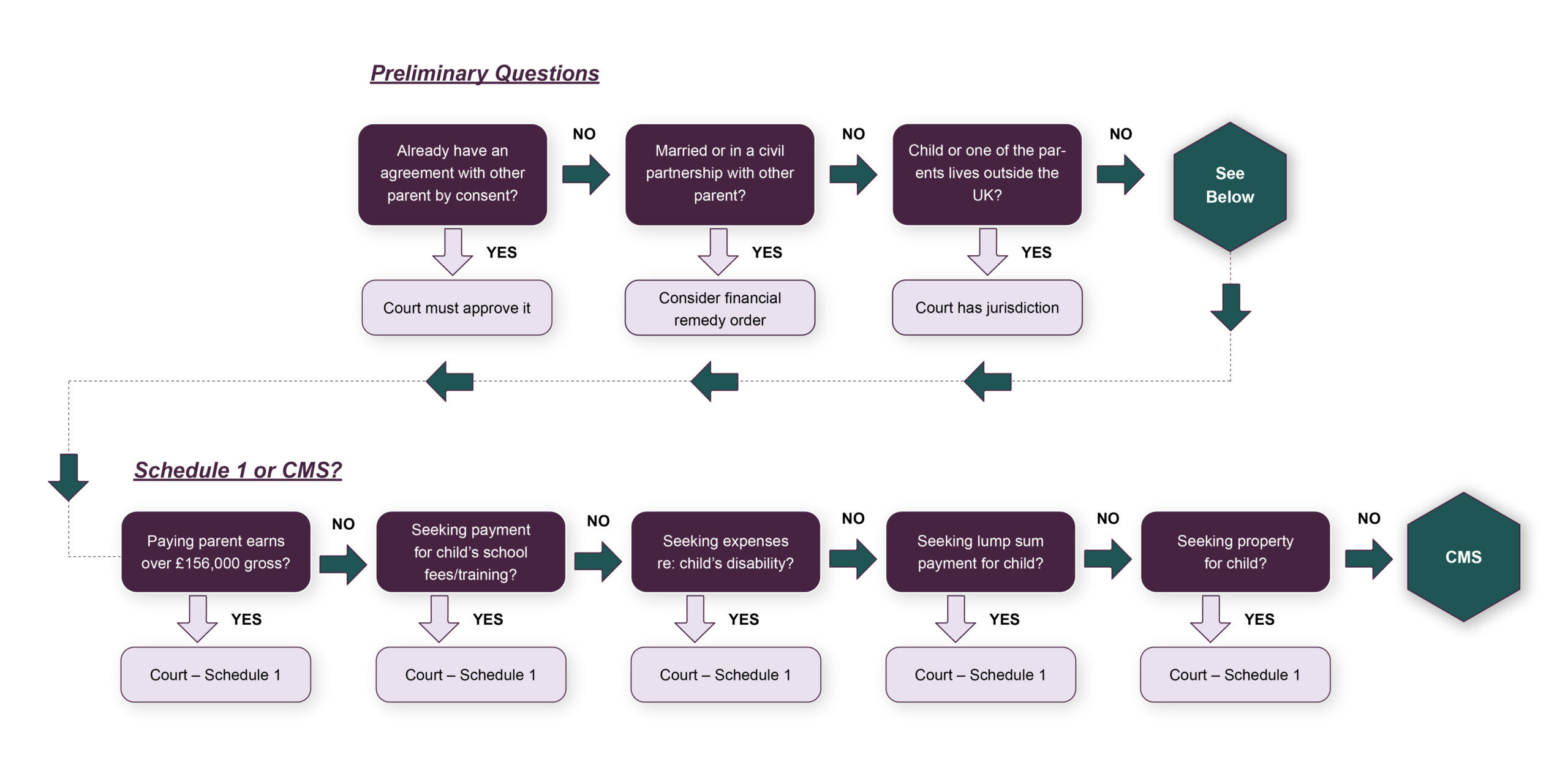
The CMS handles standard, regular child maintenance using a fixed income formula. In contrast, a Schedule 1 claim gives the court wider powers to make financial provision for a child in special circumstances when the CMS does not have jurisdiction, for instance if the payer earns over £156,000 gross per year.
As a result, Schedule 1 applications are often used in more complex situations requiring an individual assessment of a child’s needs and a family’s circumstances. Whether the CMS or the court is the appropriate route will depend on your family’s specific situation.
Before considering whether a Schedule 1 application is the most appropriate option, it’s important to identify whether there are any other factors that could affect the legal routes available to you.
For example, different considerations may apply if you already have a financial agreement in place, if you’re married or in a civil partnership, or if one of the parents or the child lives outside the UK.
To help determine whether a claim under Schedule 1 may be available in your circumstances, consider the following questions:
The flowchart below provides a quick visual guide to help you identify whether a Schedule 1 application, the CMS or another legal route might be appropriate in your circumstances.
If you’re still unsure which route applies to you, our specialist family law solicitors would be happy to help you understand your legal position and your available options. Get in touch on 0330 822 3451 or request a callback to discuss your situation.
Call one of our team to discuss starting and financing your Schedule 1 application, your rights and how we can support you through this distressing time in your life.

Head of Family & Partner











“Vanessa Friend is the stand out partner in the team. She is exceptionally bright and knowledgeable. She secures fantastic results for her client. She is a very good negotiator and very personable.”
Under Schedule 1, the court can make a range of financial orders to help meet a child’s needs. These generally fall into three categories: periodical payments, lump sum payments and property-related orders.
The court can order one parent to make regular payments for the benefit of a child. For example, this often arises where the paying parent’s income exceeds £156,000 gross per year –the maximum level that the CMS can deal with.
Depending on the circumstances, the court might order periodical payments to provide:
The court will consider the specific needs of the child and the family’s circumstances when determining whether such an order is appropriate.
The court can also order a one-off lump sum to meet a significant expense incurred for the benefit of a child, such as furnishing a property or purchasing a car.
Unlike periodical payments, a lump sum order is intended to meet a particular cost rather than provide ongoing financial support.
Partner
“One of the most common misconceptions we encounter is that Schedule 1 applications are only relevant in very high-value cases. In reality, schedule 1 applications apply in a wide range of circumstances where a child’s needs can’t be fully addressed through existing arrangements.”
In some cases, the court can make property-related orders to help meet the child’s housing needs.
For example, the court could order:
In every case, the court will consider what arrangement is needed to provide a child with a suitable and stable home.
The first step is usually to seek advice from specialist family law solicitors. This can help you understand whether a Schedule 1 application is appropriate in your circumstances, identify the issues affecting your child and assess the level of financial support that might be needed.
Before making an application to the court, you will normally need to attend a Mediation Information and Assessment Meeting (MIAM). Mediation might help you and the other parent reach an agreement without the need for court proceedings, which can save time, stress and legal costs.
If you and the other parent can’t reach an agreement, you are entitled to make a Schedule 1 claim to the family court.

No two families are the same. Whether you’re making a Schedule 1 claim or responding to one, our family law solicitors will take the time to understand your circumstances, explain your options and provide clear advice based on your child’s needs and your financial situation.
Our specialist family law team has extensive experience advising parents on complex financial issues involving children. We can support you at every stage of a Schedule 1 application, from initial advice through to mediation or court proceedings where necessary.
We understand that disputes about financial provision for children can be stressful and emotionally demanding. Our solicitors provide straightforward advice in plain English, helping you make informed decisions about the next steps for you and your family.
Our family law team is recognised by both Legal 500 and Chambers and Partners for the quality of our work. We’re also regulated by the Solicitors Regulation Authority, and all our solicitors are members of the Law Society and Resolution.
Schedule 1 applications can be complex and involve detailed financial issues concerning a child’s needs. Getting legal advice at an early stage can help you understand your options and make informed decisions about the best way forward.
Our specialist family law solicitors can advise you throughout the Schedule 1 claim process, whether you’re making a claim or responding to one. We’ll provide clear, practical advice tailored to your circumstances and work with you to achieve the best possible outcome for your child.
“Exceptional service and results. I had a fantastic experience working with Rebecca [Coates]. She was incredibly quick to respond to all my questions and explained everything in a way that was easy to understand. Most importantly, she achieved an even better result than I had hoped for. Highly recommended!”

If the CMS is the most appropriate route for your circumstances, you can apply for child maintenance directly through the UK Government’s website.
You can also use the CMS calculator to get an estimate of the payments that might be due before making an application.
If you’re unsure whether your situation should be dealt with through the CMS or under Schedule 1 of the Children Act 1989, our specialist family law solicitors would be happy to help you understand your options. Get in touch on 0330 822 3451 or request a callback.
Once an application has been issued, the court will manage the case and set out the next steps.
This will usually include:
Throughout the process, the court’s primary focus is the welfare and financial needs of the child.
When deciding a Schedule 1 claim, the family court will consider the child’s financial needs and the circumstances of everyone involved. The court’s primary focus is whether a financial order is needed to meet the child’s needs and promote their welfare.
The court will usually take into account:
No single factor determines the outcome. Instead, the court will look at the family’s circumstances as a whole before deciding whether to make an order and, if so, what level of financial provision is appropriate for the child.
In most cases, periodical payments made under a Schedule 1 order will end when the child turns 18. However, payments could continue for longer if the child remains in education or training, or if there are other circumstances that justify ongoing financial support.
The court will consider the individual facts of the case when deciding how long an order should remain in place.
In most Schedule 1 financial provision cases, each party pays their own legal costs. However, the court has the power to order one party to pay some or all of the other party’s costs in certain circumstances.
For example, a costs order may be made if a party has pursued a claim with little merit. The court may also take a different approach where a Schedule 1 application is brought on behalf of a child by a financially weaker parent. In some circumstances, legal costs incurred for the benefit of the child may form part of the wider financial issues under consideration.
If you’ve received a Schedule 1 application or a letter from a solicitor regarding financial provision for a child, it’s important to seek legal advice as soon as possible. It’s crucial not to ignore a Schedule 1 claim, as there may be court deadlines that need to be met.
Our family law solicitors regularly advise parents responding to Schedule 1 claims and can help you assess your position before taking the next step.
Hodge Jones & Allen family solicitors have been recognised as one of Chambers and Partners‘ top firms. We’re also noted by the Legal 500 for our commitment to excellence. You can rest assured that our team are highly experienced in handling even the toughest family law cases.



Hodge Jones & Allen Solicitors is proud of the many positive testimonials that we receive, reinforced by our ‘Excellent’ rating on Trustpilot. Please read through what some of our clients have had to say about their experience with our legal teams.